You do not have to become a programmer before you can understand artificial intelligence. You do not have to pretend that mathematics is easy. And you do not have to memorize a wall of new technology terms just to keep up with the world around you.
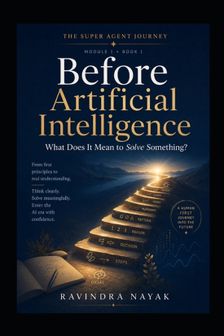
Before Artificial Intelligence: What Does It Mean to Solve Something? begins earlier-at the point where understanding actually becomes possible. Instead of starting with models, prompts, agents, or technical jargon, this book asks a more durable question: what does it mean to solve a problem at all?
From that simple beginning, the reader builds a complete mental foundation one layer at a time. You learn to see the gap between a current state and a desired state; define goals that guide action; separate useful information from noise; understand rules, decisions, thresholds, actions, outcomes, and feedback; and recognize how these pieces become workflows and reliable systems.
Then the book moves beneath the screen. Representation, measurement, records, binary, hardware, software, processors, memory, storage, input, output, programs, processes, and state are explained from first principles-without assuming a technical background. The mathematics grows just as carefully: counting, comparison, addition, subtraction, multiplication, division, fractions, percentages, averages, rates, distance, error, probability, thresholds, and expected value are introduced only when they solve a human problem first.
By the time the book reaches patterns, datasets, features, targets, similarity, prediction, machine learning, uncertainty, calibration, and responsible decision-making, the ideas no longer arrive as isolated vocabulary. They sit on foundations the reader has already built.
Throughout the journey, natural dialogues, original reflective poetry, practical exercises, visual learning maps, no-fear mathematics, and real-world examples keep the material human. The closing Value Edition turns the whole book into a reusable problem-solving compass: break complexity into meaningful chunks, separate observation from assumption, make numbers earn their meaning, test decisions, trace failure paths, and use feedback to improve the next attempt.
>If you are a student, professional, manager, creator, entrepreneur, lifelong learner, or simply a curious person who feels that the AI era is moving faster than your technical confidence, this book offers a calmer starting point. Begin before artificial intelligence. Build the layers beneath it. Then step into what comes next with a mental model you can reuse.