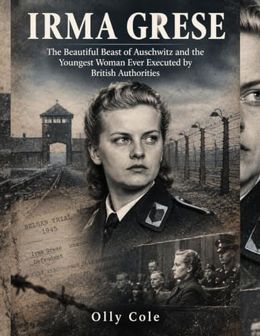
Independently Published Irma Grese: The Beautiful Beast of Auschwitz and the Youngest Woman Ever Executed by British Authorities Broché

Independently Published Irma Grese: The Beautiful Beast of Auschwitz and the Youngest Woman Ever Executed by British Authorities Broché

Tous les 1 prix et vendeurs

Choix le plus populaire – Meilleur prix !

Amazon.be· Vendeur reconnu
€ 25,18
3 à 4 joursLivraison gratuite
Check de website voor de levertijd | Gratis bezorgd > €20,-
Voir le produit
Voir le produit

Aucun avis n’a encore été écrit

Question 1 sur 4

Tu possèdes ce produit et tu aimerais donner ton avis ? Commence ci-dessous à écrire ton avis. Selon le niveau de détail, écrire un avis prend en moyenne entre 3 et 10 minutes. Avec ton opinion, tu aides les autres visiteurs à faire un meilleur choix et tu tentes chaque mois de gagner 250 € ! Clique ici pour les conditions de l’action.

Quelle note donnes-tu à ce produit ?

Spécifications

Autres caractéristiques
Nom du participant responsable du marché dans l'UE
Libri GmbH
Largeur de l'emballage
21,6 cm
Hauteur de l'emballage
0,4 cm
Longueur de l'emballage
27,9 cm
Antidérapant
Non
Dans un ensemble
Non
EAN
9798175219341
EAN
9798175219341

Description du produit

She was twenty-two years old when the hangman placed the noose around her neck, already the youngest woman ever formally executed by British authorities. Survivors of Auschwitz called her the Hyena. Journalists at her trial called her the Beautiful Beast. Both names point to the same disturbing truth: Irma Grese does not fit comfortably into any category history has prepared for its villains.Born to a modest agricultural family in rural Mecklenburg, Irma Grese grew up in a household unremarkable by every ordinary measure, until her mother's death and a fractured relationship with her father sent her searching for structure and belonging elsewhere. She found it, at eighteen, in the guard training program at Ravensbrück, and within a matter of months she had transformed into one of the most feared figures in the entire Nazi concentration camp system. By the time she was transferred to Auschwitz-Birkenau, she had become notorious among the prisoners under her authority for a level of calculated cruelty that distinguished her even among a guard corps trained specifically to suppress ordinary human empathy.This book traces Irma Grese's complete story, from a childhood shaped by grief and quiet withdrawal, through her rapid rise within the S.S. guard hierarchy at Ravensbrück and Auschwitz, to the collapse of the eastern camp system and her final posting at Bergen-Belsen, where British forces found her among the camp's staff at liberation in April 1945. It follows the war crimes tribunal at Lüneburg that would fix her image permanently in history, and the December morning at Hameln prison when her life came to its end.Drawing on survivor testimony, courtroom records, and the accounts of those who served alongside her, this account resists the temptation to reduce Irma Grese to either a simple monster or a mere product of her circumstances. It examines instead the specific institutions, relationships, and choices that shaped her, and confronts the uncomfortable questions her case continues to raise: how an apparently ordinary young woman became capable of such sustained brutality, and why history has so often treated female perpetrators of mass violence as aberrations rather than subjects deserving the same serious study as their male counterparts.Readers of Holocaust history, the Second World War, and the psychology of atrocity will find in Irma Grese's story a difficult but necessary window into how the machinery of the camps operated at its most immediate and personal level, carried out not only by distant administrators but by guards barely out of adolescence who held absolute power over those in their charge.Her story does not offer comfortable answers. It offers something more valuable: a clearer understanding of how cruelty is made, and why remembering it matters still.