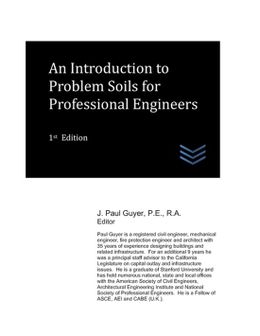

An Independently Published An Introduction to Problem Soils for Professional Engineers Paperback

An Independently Published An Introduction to Problem Soils for Professional Engineers Paperback

Tous les 2 prix et vendeurs

Hot Deal Alert – Meilleur prix !
Amazon.be· Vendeur reconnu
€ 44,31
3 à 4 joursLivraison gratuite
Check de website voor de levertijd | Gratis bezorgd > €20,-
Voir le produit
Voir le produit
Amazon.be Marketplace· Marketplace
€ 44,31
3 à 4 joursLivraison gratuite
Check de website voor de levertijd | Gratis bezorgd > €20,-
Voir le produit
Voir le produit

Spécifications

Overige kenmerken
Verpakking breedte
21,6 cm
Verpakking lengte
27,9 cm
Product gewicht
304 g
Verpakking hoogte
0,6 cm
EAN
9798183589436
Verpakkingsgewicht
304 g

Description du produit

Most of the design techniques that will be described in this discussion will generically characterize soils as sand or coarse-grained (often called "cohesionless") or as clay or fine-grained (often called "cohesive"). This is a useful expedient in that the two soil groups represent the endpoints of common soil behavior. Sands are most often drained under normal types of loading, and the strength parameters can be represented as a linear envelope with a slope equal to the effective stress friction angle, φ' (with cʹ = 0), or a curved or non-linear envelope represented by a power function or other equation. Clays4 can be undrained in the short term and drained in the long term; therefore, both types of strength parameters (drained and undrained) are needed for the various types of design methods presented. Sands are often considered to be relatively incompressible and/or the compression occurs quickly. Clays are considered to be much more compressible, and the compression occurs more slowly for an extended time period. Separating the soils into two major groups, sands and clays, is very useful since these are the recognized endpoints for both drained vs. undrained behavior as well as relatively incompressible vs. compressible behavior. However, there are soils that fit within these two groups that can exhibit special problems. In addition, there are other soils with specific names, such as loess, that can be problematic for the design methods presented. This section is organized by listing the different soils that are identified as being problematic in the upcoming chapters and, in general, geotechnical engineering practice.

Avis

Aucun avis n’a encore été écrit

Tu possèdes ce produit et tu aimerais donner ton avis ? Commence ci-dessous à écrire ton avis. Selon le niveau de détail, écrire un avis prend en moyenne entre 3 et 10 minutes. Avec ton opinion, tu aides les autres visiteurs à faire un meilleur choix et tu tentes chaque mois de gagner 250 € ! Clique ici pour les conditions de l’action.

Quelle note donnes-tu à ce produit ?