
Choix le plus populaire – Meilleur prix !

Amazon.be Marketplace· Marketplace
€ 44,16
5 à 6 joursLivraison gratuite
Check de website voor de levertijd | Gratis bezorgd > €20,-

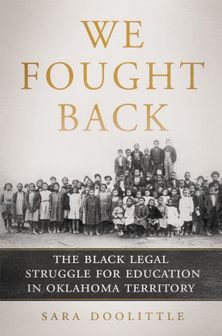
Most people are familiar with the landmark 1954 Supreme Court decision Brown v. Board of Education, which held that state laws mandating racial segregation in public schools were unconstitutional. But what about the court cases that far preceded, and informed, this national ruling? They took place in smaller courts, in unsung parts of the United States, including in Oklahoma Territory. There, decades before Brown v. Board, Black citizens worked to challenge legislation and local school board restrictions that segregated their schools. In We Fought Back, Sara Doolittle analyzes a rich array of previously unexplored court challenges during Oklahoma's territorial period (1889–1907), revealing how Black residents' cases reshaped understandings of race, citizenship, and the federal role in American schooling.
After the Civil War, Black homesteaders sought a refuge and new life in Oklahoma Territory. There—before 1907, when the state constitution and subsequent laws would enshrine Jim Crow—Black homesteaders held equal rights to land under the Homestead and Organic Acts. They had historic access to integrated education in other states, in neighboring Indian Territory, and on military posts. As national jurisprudence increasingly equated segregation with equality after Plessy v. Ferguson (1896), Black families in Oklahoma Territory resisted this narrowing of their rights. Oklahoma's territorial courts heard more cases brought by Black families demanding educational access than any other state in the nation. And in striking contrast to developments elsewhere, these families received sympathetic rulings from federally appointed judges in the territory's early courts.
By examining the stories behind cases such as Porter v. Commissioners of Kingfisher County (1898) and Simmons v. Board of Education of the City of Muskogee (1938), Doolittle reveals a dynamic and contested landscape, a place where acceptance of "separate but equal" was anything but the foregone conclusion standard histories have suggested. Through compelling and accessible accounts of real Oklahomans demanding educational equality, We Fought Back explores the deep roots of activism in the state and illuminates a critical moment of convergence between law, public education, and the meaning of Black citizenship.
Tu possèdes ce produit et tu aimerais donner ton avis ? Commence ci-dessous à écrire ton avis. Selon le niveau de détail, écrire un avis prend en moyenne entre 3 et 10 minutes. Avec ton opinion, tu aides les autres visiteurs à faire un meilleur choix et tu tentes chaque mois de gagner 250 € ! Clique ici pour les conditions de l’action.
