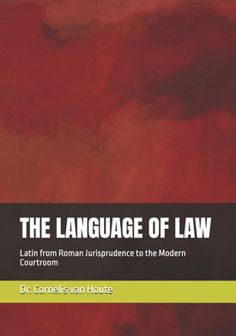
Most Latin legal maxims aren't Roman. This book tells you which ones actually are - and proves it.
Nullum crimen sine lege sounds like it comes straight from the Twelve Tables. It doesn't - a German criminal-law reformer coined it in 1801. Audi alteram partem has been quoted in courtrooms for centuries as ancient wisdom. Its earliest known source is a playwright, not a jurist. Even lex superior derogat inferiori, the bedrock principle of modern constitutional review, owes more to a twentieth-century Austrian legal theorist than to anything Justinian ever compiled.
The Language of Law is a history of legal Latin that refuses to take the Latin at face value. Rather than another list of phrases and translations, it traces where each expression actually came from - genuine classical doctrine, medieval canon law, early modern natural-law theory, or flat-out modern invention dressed in a dead language for gravitas - and shows what's really at stake when a lawyer, judge, or student gets the history wrong.
The book moves in five parts: how Latin became Rome's working legal language and how that language was transmitted across two thousand years; the core vocabulary of persons, property, obligations, and crime as the Roman jurists actually used it; the interpretive toolkit - a fortiori, a contrario, lex specialis - that still shapes legal argument today; worked case studies tracing specific Roman solutions into modern civil-law and common-law doctrine; and a sustained examination of the maxims most likely to mislead, including a full classification of which are genuinely classical, which are medieval, and which are modern coinages in a toga.
It closes with a 150-entry field guide - persons and things, obligations and delict, procedure and crime, interpretive maxims, everyday legal Latin - each entry giving literal meaning, juridical meaning, Roman background (or the honest absence of one), historical development, modern application, a common misconception, and pronunciation.
>Substance before style. Evidence before assertion. Precision before ornament.
Cornelis van Houte, LL.D.