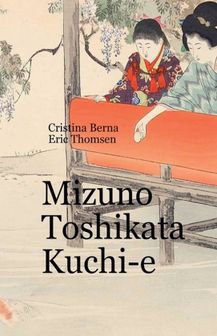
Mizuno Toshikata Kuchi-e Paperback

Mizuno Toshikata Kuchi-e Paperback

Tous les 2 prix et vendeurs

Choix le plus populaire – Meilleur prix !

Amazon.be· Vendeur reconnu
€ 64,36
3 à 4 joursVerz. € 4,30
Check de website voor de levertijd | Gratis bezorgd > €20,-
Voir le produit
Voir le produit
Amazon.be Marketplace· Marketplace
€ 64,36
3 à 4 joursVerz. € 4,30
Check de website voor de levertijd | Gratis bezorgd > €20,-
Voir le produit
Voir le produit

Spécifications

Belangrijkste kenmerken
EAN
9785223316039

Description du produit

Toshikata was born Mizuno Kumajir¿ in 1866 in the Kanda district of Tokyo to a plasterer's family. Abt 1879 when he was about thirteen years old, his father, Nonaka Kichigoro, sent him to study with Yoshitoshi Tsukioka (1839-1892), but his father then removed him from Yoshitoshi's studio and sent him to a relative of his mother to earn his living as a painter of ceramics. However, in 1882 he returned to Yoshitoshi's studio.Mizuno Toshikata belonged to a generation of Japanese artists, including Chikanobu Toyohara (1838-1912), Ogata Gekko (1859-1920), Kobayashi Kiyochika (1847-1915), and Tomioka Eisen (1864-1905), whose artistic careers were shaped by unfavorable historical timing. However, several were hired to illustrate literary magazines with wonderful Kuchi-e prints. Toshikata also published a number of series of bijin prints and genre scenes, featuring women and children.After the turn of the century, Toshikata remained a well-known painter, printmaker and illustrator and is credited with raising the status of painters from the ukiyo-e lineage.In 1887, on Yoshitoshi's recommendation, he succeeded Yoshitoshi as the illustrator at the newspaper Yamato shinbun, where he achieved acclaim. He worked at the Yamato shinbun until 1894. During the Sino-Japanese War (1894-1895), he created a large body of work depicting battle scenes. His work is some of the best to be produced during that period. He died in 1908.Mizuno Toshikata did not just do Kuchi-e, as the title of this book indicates, he also did great series of free-standing prints. The title serves to anchor him in time and the artistic development of Japanese prints, where the Kuchi-e gives a fantastic view into the Meiji society and its social issues.

Avis

Aucun avis n’a encore été écrit

Tu possèdes ce produit et tu aimerais donner ton avis ? Commence ci-dessous à écrire ton avis. Selon le niveau de détail, écrire un avis prend en moyenne entre 3 et 10 minutes. Avec ton opinion, tu aides les autres visiteurs à faire un meilleur choix et tu tentes chaque mois de gagner 250 € ! Clique ici pour les conditions de l’action.

Quelle note donnes-tu à ce produit ?