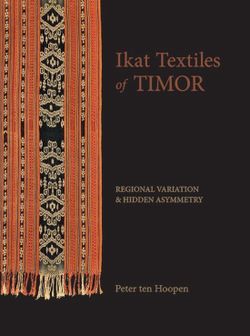
Ikat Libri GmbH Ikat Textiles of Timor: Regional Variation and Hidden Asymmetry

Ikat Libri GmbH Ikat Textiles of Timor: Regional Variation and Hidden Asymmetry

Tous les 2 prix et vendeurs

Choix le plus populaire – Meilleur prix !

Amazon.be· Vendeur reconnu
€ 79,23
InconnuLivraison gratuite
Check de website voor de levertijd | Gratis bezorgd > €20,-
Voir le produit
Voir le produit
Amazon.be Marketplace· Marketplace
€ 79,23
InconnuLivraison gratuite
Check de website voor de levertijd | Gratis bezorgd > €20,-
Voir le produit
Voir le produit

Spécifications

Overige kenmerken
Meerdere temperatuurzones
Non
Magnetronfunctie
Non
Smart Home Platform
Non
Kinderslot
Non
Pizzaprogramma
Non
Verpakking breedte
24,5 cm
Voorgeprogrammeerde maaltijden
Non
Bediening via mobiele app
Non
Verpakking hoogte
3,3 cm
Airfry functie
Non
Oven accessoires inbegrepen
Non
Naam verantwoordelijke marktdeelnemer in de EU
Libri GmbH
Verpakkingsgewicht
2,04 kg
Verpakking lengte
31,9 cm
Functie snel voorverwarmen
Non
Alleen onderwarmte mogelijk
Non
CE markering
Non
Kerntemperatuursensor
Non
EAN
9789887471059
Taal handleiding
en
Product gewicht
2,04 kg
Telescopische rails
Non
Uitgesteld start
Non
Ondersteuning met updates
Non
Betaalde diensten vereist
Non
Bluetooth vereist
Non
Mobiele data verbinding mogelijk
Non
Delen van gebruikersgegevens vereist
Non
Wifi vereist
Non
Kan zelfstandig met internet verbinden
Non
App vereist voor volledige functionaliteit
Non
Combinatie magnetron grill
Non
Hete lucht functionaliteit
Non
Grill functie
Non
Boven- en onderwarmte
Non
Product hoogte
33 cm
Product breedte
2,45 m
Product lengte
3,19 m
Ontdooi functionaliteit
Non

Description du produit

Ikat Textiles of Timor offers an in-depth overview of regional textile styles from both West and East Timor, while also contributing significant new insights into their design traditions. In academic literature, the ikated men’s wraps from Timor have long been described as symmetrical. However, Dr Peter ten Hoopen’s examination of early examples from museums and private collections reveals that, historically, two thirds of these textiles were actually asymmetrical. This discovery challenges an academic consensus that has persisted since 1912, and highlights a previously overlooked level of creative ingenuity—inviting greater admiration for the women who wove these complex designs. Today’s ikat weavers on Timor, like many foreign scholars before them, seem unaware that asymmetry was once a dominant design principle. Many continue to assert that perfect symmetry has always been the tradition. Yet the historical textiles tell a different story. Ten Hoopen’s groundbreaking findings justify his focus on early specimens, which often display a greater degree of design sophistication than their contemporary counterparts. It is striking that earlier researchers failed to recognise or report the prevalence of asymmetry in Timorese textiles. In early pieces, asymmetry is not only present but often dominant. This oversight reflects a broader pattern of neglect: textiles have historically been marginalised in Southeast Asian material culture studies, overshadowed by architecture, sculpture, weaponry, and jewellery. The author hopes that his historical investigations help correct this imbalance by demonstrating that these textiles embody far more artistic ingenuity, intellectual depth, and craftswomanship than previously acknowledged.

Avis

Aucun avis n’a encore été écrit

Tu possèdes ce produit et tu aimerais donner ton avis ? Commence ci-dessous à écrire ton avis. Selon le niveau de détail, écrire un avis prend en moyenne entre 3 et 10 minutes. Avec ton opinion, tu aides les autres visiteurs à faire un meilleur choix et tu tentes chaque mois de gagner 250 € ! Clique ici pour les conditions de l’action.

Quelle note donnes-tu à ce produit ?