
Choix le plus populaire

Amazon.be Marketplace· Marketplace
€ 37,70
3 à 4 joursLivraison gratuite
Check de website voor de levertijd | Gratis bezorgd > €20,-


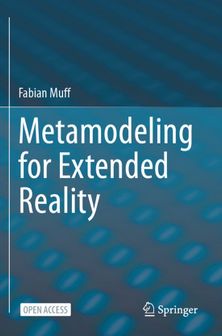
This open access book which is based on the author’s dissertation in 2024 explores the challenges of metamodeling in the context of extended reality and emphasizes the need for new concepts in metamodeling to effectively combine it with extended reality technologies. The central question of this work is how metamodeling can be used “in” and “for” extended reality.
The book is structured in nine chapters: Chapter 1 introduces the topic by providing background information and outlining the research objectives, questions, methodology and structure. Chapter 2 delves into the existing literature and developments in the field. It covers various aspects of modeling, such as conceptual, enterprise, and metamodeling, as well as extended reality (XR), virtual reality (VR), augmented reality (AR), and the metaverse. Next, chapter 3 presents the generic requirements for metamodeling for augmented and virtual reality by systematically deriving use cases for joining AR and metamodeling. Chapter 4 then identifies specific requirements for integrating metamodeling with XR, such as coordinate mappings, visualization of model components, detection and tracking, context, or interaction. Subsequently, chapter 5 introduces a new domain-specific visual modeling language for creating augmented reality scenarios, particularly within the context of metamodeling, before chapter 6 outlines the conceptualization and design of a 3D enhanced metamodeling platform considering extended reality, detailing its structure, components, and the interconnection of its elements. Chapter 7 then presents the initial implementation of the various components of this modeling platform, and chapter 8 evaluates the newly introduced platform both theoretically and empirically. Eventually, chapter 9 concludes the book by an alignment with the initial research questions, discussing limitations, and provides a final summary and an outlook for further research.
This book mainly aims at researchers in conceptual modeling, especially in projects related to XR, VR, or AR, as the presented new domain-specific modeling method for creating workflows for XR/VR/AR applications does not assume specific prior programming knowledge.
Tu possèdes ce produit et tu aimerais donner ton avis ? Commence ci-dessous à écrire ton avis. Selon le niveau de détail, écrire un avis prend en moyenne entre 3 et 10 minutes. Avec ton opinion, tu aides les autres visiteurs à faire un meilleur choix et tu tentes chaque mois de gagner 250 € ! Clique ici pour les conditions de l’action.
