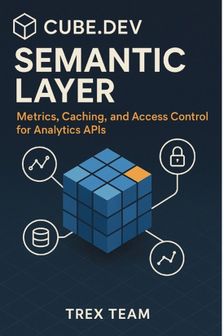

Cube.dev Semantic Layer: Metrics, Caching, and Access Control for Analytics APIs

Cube.dev Semantic Layer: Metrics, Caching, and Access Control for Analytics APIs

Tous les 2 prix et vendeurs

Hot Deal Alert – Meilleur prix !
Amazon.be· Vendeur reconnu
€ 34,45
3 à 4 joursLivraison gratuite
Check de website voor de levertijd | Gratis bezorgd > €20,-
Voir le produit
Voir le produit
Amazon.be Marketplace· Marketplace
€ 34,45
3 à 4 joursLivraison gratuite
Check de website voor de levertijd | Gratis bezorgd > €20,-
Voir le produit
Voir le produit

Spécifications

Overige kenmerken
Verpakkingsgewicht
358 g
Taal handleiding
en
Product breedte
15,2 cm
Verpakking breedte
15,2 cm
Product lengte
22,9 cm
Product hoogte
1,4 cm
Verpakking lengte
22,9 cm
Verpakking hoogte
1,4 cm
EAN
9798896653233

Description du produit

"Cube.dev Semantic Layer: Metrics, Caching, and Access Control for Analytics APIs"This book is a deep technical guide to building a governed, high-performance semantic layer with Cube.dev for teams who already ship production analytics. If you maintain a metrics platform, power embedded analytics, or expose analytics APIs to multiple consumers, you've likely felt the pain of inconsistent definitions, runaway warehouse spend, and security rules scattered across tools. Here you'll develop a rigorous mental model of Cube's request flow-where semantics are enforced, where performance is won or lost, and how to keep behavior predictable under real-world concurrency.You'll learn to model durable semantic contracts with cubes, views, members, joins, and time dimensions; engineer measures and dimensions that remain correct across REST, GraphQL, and SQL consumers; and validate metric integrity with testing and observability workflows. The book then goes operational: designing two-level caching (result cache plus pre-aggregations), shaping API workloads for cache efficiency, tuning freshness via refresh keys, and orchestrating background refresh safely. Finally, it treats security as a first-class runtime input-JWT-driven security context, Data Access Policies (member/row/column controls), and multi-tenant isolation patterns that prevent cache-based data leaks.Expect advanced trade-offs, failure modes, and upgrade/compatibility considerations (notably for Cube Store and policy features). Readers should be comfortable with SQL, data modeling, and deploying services in production

Avis

Aucun avis n’a encore été écrit

Tu possèdes ce produit et tu aimerais donner ton avis ? Commence ci-dessous à écrire ton avis. Selon le niveau de détail, écrire un avis prend en moyenne entre 3 et 10 minutes. Avec ton opinion, tu aides les autres visiteurs à faire un meilleur choix et tu tentes chaque mois de gagner 250 € ! Clique ici pour les conditions de l’action.

Quelle note donnes-tu à ce produit ?