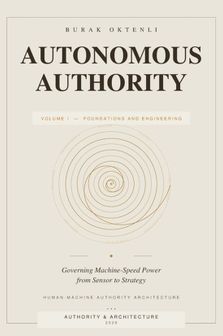
Autonomous Authority - Volume I Hardcover

Autonomous Authority - Volume I Hardcover

Tous les 2 prix et vendeurs

Choix le plus populaire – Meilleur prix !

Amazon.be· Vendeur reconnu
€ 115,23
3 à 4 joursVerz. € 9,99
Check de website voor de levertijd | Gratis bezorgd > €20,-
Voir le produit
Voir le produit
Amazon.be Marketplace· Marketplace
€ 115,23
3 à 4 joursVerz. € 9,99
Check de website voor de levertijd | Gratis bezorgd > €20,-
Voir le produit
Voir le produit

Spécifications

Overige kenmerken
Verpakking breedte
17,8 cm
Verpakking hoogte
2,7 cm
Verpakking lengte
25,4 cm
Verpakkingsgewicht
1,05 kg
EAN
9798995875765
EAN
9798995875765

Description du produit

For three centuries, military command has rested on a single architectural assumption: that human authority can be exercised within the time the operational environment allows. Machine-speed warfare has invalidated that assumption. The question is no longer whether autonomous systems will govern decisions humans cannot reach in time. It is whether those decisions will be governed by anything at all.Autonomous Authority Volume I: Foundations and Engineering treats authority migration, the transfer of decision rights from human commanders to autonomous systems, as a measurable parameter governed by three structural variables: temporal compression (¿), system confidence (C), and escalation coupling (E). From these primitives the book derives the Human-Machine Authority Architecture (HMAA), a deployable stack of cryptographic, computational, and audit primitives that makes machine-speed action accountable to human institutions.The volume specifies the six engineering modules that constitute the architecture: sensor attestation (SATA), adversarial deception detection (ADARA), real-time authority computation (the HMAA Engine), multi-agent integrity verification (MAIVA), flash-war latency architecture (FLAME), and cognitive authority recovery (CARA). Each module is given formal definitions, threat models, performance requirements, and cryptographic primitives. Together they form a coherent stack that can be specified, audited, and verified.The framework is validated against four conflict archetypes derived from contemporary doctrinal analysis (distributed swarm, cognitive denial, orbital denial, economic coercion), and the volume closes with a retroactive engineering simulation against the 2008 financial crisis, the most thoroughly documented governance failure of autonomous decision systems on record.Written for defense planners, autonomous systems engineers, AI governance researchers, and policy professionals working at the intersection of formal methods and operational doctrine, Volume I establishes the architectural foundation on which the trilogy's domain-specific and empirical work builds. It treats authority not as a political concept to be debated but as an engineering quantity to be specified, computed, and verified.The framework is technical. The argument is institutional. The stakes are civilizational.

Aucun avis n’a encore été écrit

Question 1 sur 4

Tu possèdes ce produit et tu aimerais donner ton avis ? Commence ci-dessous à écrire ton avis. Selon le niveau de détail, écrire un avis prend en moyenne entre 3 et 10 minutes. Avec ton opinion, tu aides les autres visiteurs à faire un meilleur choix et tu tentes chaque mois de gagner 250 € ! Clique ici pour les conditions de l’action.

Quelle note donnes-tu à ce produit ?