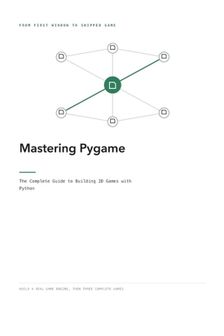

Mastering Independently Published Mastering Pygame: The Complete Guide to Building 2D Games with Python

Mastering Independently Published Mastering Pygame: The Complete Guide to Building 2D Games with Python

Tous les 2 prix et vendeurs

Hot Deal Alert – Meilleur prix !
Amazon.be· Vendeur reconnu
€ 22,73
3 à 4 joursLivraison gratuite
Check de website voor de levertijd | Gratis bezorgd > €20,-
Voir le produit
Voir le produit
Amazon.be Marketplace· Marketplace
€ 22,73
3 à 4 joursLivraison gratuite
Check de website voor de levertijd | Gratis bezorgd > €20,-
Voir le produit
Voir le produit

Spécifications

Productinformatie
Type drager
Paperback
Type indicator
Non
EAN
9798170369850
Merk
Independently Published
EAN
9798170369850
Talen product
en
Virtual Reality mogelijkheden
Non
4K-gaming ondersteuning
Non
Personage van toepassing
Non
Naam verantwoordelijke marktdeelnemer in de EU
Libri GmbH
Verpakking breedte
15,2 cm
Verpakking hoogte
1,6 cm
Verpakking lengte
22,9 cm
Online co-op
Non
Split screen
Non
Online option games
Non

Description du produit

Pygame has launched more game-development careers than any other Python library, and it is still the fastest way to turn an idea into a playable game. But almost every tutorial stops at a bouncing ball or a single-file clone of a 1970s arcade game, and leaves you staring at a thousand-line script that breaks every time you add a feature. Mastering Pygame is the book that covers everything after that point. This is a full-length, practical guide to building 2D games with Pygame the way real software gets built: with an architecture, with tests, and with a distribution pipeline. It is written for pygame-ce, the actively developed community edition of the library, and it assumes you are comfortable with Python but know nothing about game development. The first third of the book covers the library and the fundamentals: the game loop and why delta time and a fixed-timestep accumulator matter, surfaces and blitting, keyboard and gamepad input, sprites and groups, spritesheets and animation, collision detection and resolution, 2D vector math, and enemy AI with state machines, perception, steering, and A* pathfinding. The middle third is the architecture that keeps a game buildable past week six: scenes on a stack, entities composed from components instead of a class hierarchy, systems that run in a known order, an event bus, tile maps authored in the Tiled editor, procedural generation, smooth scrolling cameras with deadzones and screen shake, and a dedicated treatment of game feel and juice. The final third is the production systems tutorials skip: particle effects, adaptive audio and a layered music mixer, a UI toolkit with menus that navigate by keyboard or gamepad, text rendering with a typewriter dialogue system and localization, platformer physics with coyote time and jump buffering, save systems that survive a crash mid-write and migrate across versions, profiling and optimization, testing and debugging, multiplayer basics, advanced rendering with lighting and shaders, packaging with PyInstaller, shipping to the browser with pygbag, and playtesting and launch. Then you build three complete games end to end. Starfield Assault is an arcade shooter built first as a rough prototype and then refactored, on the page, into clean scene-and-component code. Hollow Ascent is a physics platformer with tile levels, a follow camera, and a jump that took decades of industry work to get right. Emberfall is a top-down adventure with NPCs, branching dialogue, an inventory, combat, quests, and a working save system that exercises nearly every system in the book at once. By the end you will have a reusable engine layer and the judgment to know which techniques a given game actually needs. If you have ever abandoned a game project because the code collapsed under its own weight, this book is about the architecture that lets you finish.

Aucun avis n’a encore été écrit

Question 1 sur 4

Tu possèdes ce produit et tu aimerais donner ton avis ? Commence ci-dessous à écrire ton avis. Selon le niveau de détail, écrire un avis prend en moyenne entre 3 et 10 minutes. Avec ton opinion, tu aides les autres visiteurs à faire un meilleur choix et tu tentes chaque mois de gagner 250 € ! Clique ici pour les conditions de l’action.

Quelle note donnes-tu à ce produit ?