Description du produit
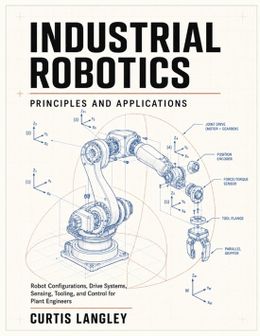
Design robot cells that work on the plant floorIndustrial robots deliver value only when mechanics, motion, sensing, tooling, controls, safety, and production requirements operate as one system. This engineering textbook gives plant engineers, integrators, technicians, and advanced students a practical framework for specifying, analyzing, commissioning, and supporting industrial robot applications.Beginning with robot configurations and work envelopes, Curtis Langley develops the mathematics of coordinate frames, kinematics, Jacobians, singularities, trajectories, and servo drives without losing sight of physical equipment. Detailed chapters connect electric, hydraulic, and pneumatic actuation to structural loads, sensors, machine vision, end effectors, robot programming, PLC handshakes, and industrial networks.Build judgment through worked engineering- Use governing equations to estimate reach, torque, cycle time, grip force, stopping distance, uncertainty, availability, and economic return.- Follow worked examples drawn from welding, dispensing, machine tending, palletizing, assembly, inspection, and mixed-model production.- Interpret technical figures, comparison tables, derivations, commissioning evidence, and troubleshooting data.- Practice with end-of-chapter problems and complete answers grounded in the chapter material.Later chapters show how to conduct risk assessment, validate safety functions, qualify process capability, calibrate tools and workobjects, execute run-at-rate testing, organize preventive and condition-based maintenance, and evaluate automation investments. The final system-design chapter brings capacity, discounted cash flow, energy, cybersecurity, data architecture, and scalable plant standards into one decision process.The result is a rigorous field-oriented reference for readers who need to move from robot fundamentals to defensible production decisions.