
Choix le plus populaire

Amazon.be· Vendeur reconnu
€ 31,79
3 à 4 joursLivraison gratuite
Check de website voor de levertijd | Gratis bezorgd > €20,-


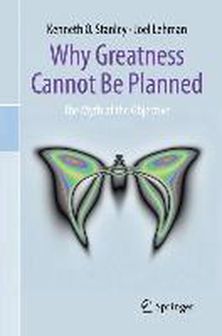
Controversial at its heart, yet refreshingly provocative, this book challenges readers to consider life without a destination and discovery without a compass.
"What is your ultimate goal - your true objective - when you pick up a book? The authors of this one believe that there may be no objective at all involved, just a diffuse feeling that a book can change the way you look at the world. They may be right."
- Christos Papadimitriou, C. Lester Hogan Professor of Computer Science, University of California, Berkeley and Co-author of the New York Times Best Seller “Logicomix”
"One of the original aspirations of Artificial Intelligence researchers was to help all of us, as thinking beings, understand ourselves better. Stanley and Lehman are among the few who have managed to achieve this. In this book they not only shed light on a glaring bias in the way we approach the creation of intelligent machines, but have also identified this bias at work in many aspects of our society. It is not every day that a technical book so clearly reveals something new about how we live our own lives and how we might enrich them. I cherish such ararity, and I urge others to as well. "
- Josh Bongard, Associate Professor of Computer Science, University of Vermont
"The ideas in this book have revolutionized the field of evolving artificial intelligence. They also help explain why biological evolution, science, and human culture are creative, endlessly innovative processes. Stanley and Lehman's theories are helpful for anyone who wants to foster a culture of innovation in their organization and within their own mind."
"Objectives in our lives and careers, and the endeavor to achieve them, can sometimes cause stress and feelings of underachievement. But do we always need objectives? This book challenges common beliefs in our culture and society, revealing indisputable evidence that the biggest discoveries in the arts and sciences are not driven by objectives. The reading providesan uplifting new perspective on creativity, innovation, and happiness."
- Andrea Soltoggio, Lecturer in Computer Science, Loughborough University, UK
Kenneth O. Stanley and coauthor Joel Lehman are both experienced artificial intelligence researchers whose scientific discoveries led to the insights in “Why Greatness Cannot Be Planned.” Stanley, an associate professor at the University of Central Florida, has published over 80 peer-reviewed articles (10 of which have won best paper awards) and is regularly invited to speak at venues across the world. Lehman is currently a post-doctoral fellow at the University of Texas at Austin. In August 2015 he begins as an assistant professor at the IT University of Copenhagen.
Why does modern life revolve around objectives? From how science is funded, to improving how children are educated -- and nearly everything in-between -- our society has become obsessed with a seductive illusion: that greatness results from doggedly measuring improvement in the relentless pursuit of an ambitious goal. In Why Greatness Cannot Be Planned, Stanley and Lehman begin with a surprising scientific discovery in artificial intelligence that leads ultimately to the conclusion that the objective obsession has gone too far. They make the case that great achievement can't be bottled up into mechanical metrics; that innovation is not driven by narrowly focused heroic effort; and that we would be wiser (and the outcomes better) if instead we whole-heartedly embraced serendipitous discovery and playful creativity.
Controversial at its heart, yet refreshingly provocative, this book challenges readers to consider life without a destination and discovery without a compass.
Tu possèdes ce produit et tu aimerais donner ton avis ? Commence ci-dessous à écrire ton avis. Selon le niveau de détail, écrire un avis prend en moyenne entre 3 et 10 minutes. Avec ton opinion, tu aides les autres visiteurs à faire un meilleur choix et tu tentes chaque mois de gagner 250 € ! Clique ici pour les conditions de l’action.
