
Choix le plus populaire

Amazon.be Marketplace· Marketplace
€ 206,13
3 à 4 joursLivraison gratuite
Check de website voor de levertijd | Gratis bezorgd > €20,-


Tu possèdes ce produit et tu aimerais donner ton avis ? Commence ci-dessous à écrire ton avis. Selon le niveau de détail, écrire un avis prend en moyenne entre 3 et 10 minutes. Avec ton opinion, tu aides les autres visiteurs à faire un meilleur choix et tu tentes chaque mois de gagner 250 € ! Clique ici pour les conditions de l’action.
The book discusses how manualised treatments impact the therapist and their practice with clients, challenging the notion that measuring and repeating manualised psychotherapeutic practice always moves toward best practice.
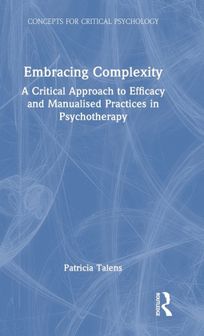
Embracing Complexity: A Critical Approach to Efficacy and Manualised Practices in Psychotherapy considers the implications for psychotherapeutic practice and research when these are required to demonstrate ‘efficacy’ through repeatable models and manualised practices. This book discusses how manualised treatments impact the therapist and their practice with clients, challenging the notion that measuring and repeating manualised psychotherapeutic practice always moves toward best practice.
It considers the growth of manualised interventions such as cognitive behavioural therapy (CBT) which have undergone rapid expansion and implementation in recent decades and are often regarded as the gold standard of measurable, evidence-based treatment. However, manualised practices may be critiqued as reductive and failing to incorporate the complexities of the self as a whole into the therapeutic relationship, instead over-relying on the reduction of symptoms relating to one diagnosis. This book considers whether standardisation in psychotherapeutic research and practice can sacrifice key therapeutic and relational elements in the name of conformity and how training and standardisation can monopolise the psychotherapeutic space. Adopting a critical psychological approach, this book explores the current situation in psychology, showcases the voice of different practitioners, and explores what is gained and what is lost through the increasing adoption of manualised therapies.
By pointing out alternative paths for therapists that emerge from a fuller and unfiltered understanding of the psychotherapeutic space, this book will be of great interest to students and researchers in the areas of psychotherapy, critical psychology, and phenomenological studies, and to mental health professionals and trainees.
