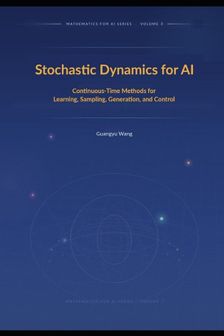
Bestai Press Stochastic Dynamics for AI: Continuous-Time Methods for Learning, Sampling, Generation, and Control Paperback

Bestai Press Stochastic Dynamics for AI: Continuous-Time Methods for Learning, Sampling, Generation, and Control Paperback

Tous les 2 prix et vendeurs

Choix le plus populaire
Prix le plus bas
Amazon.be Marketplace· Marketplace
€ 36,31
3 à 4 joursLivraison gratuite
Check de website voor de levertijd | Gratis bezorgd > €20,-
Voir le produit
Voir le produit
Prix le plus bas
Amazon.be· Vendeur reconnu
€ 36,31
3 à 4 joursLivraison gratuite
Check de website voor de levertijd | Gratis bezorgd > €20,-

Voir
Voir le produit

Aucun avis n’a encore été écrit

Question 1 sur 4

Tu possèdes ce produit et tu aimerais donner ton avis ? Commence ci-dessous à écrire ton avis. Selon le niveau de détail, écrire un avis prend en moyenne entre 3 et 10 minutes. Avec ton opinion, tu aides les autres visiteurs à faire un meilleur choix et tu tentes chaque mois de gagner 250 € ! Clique ici pour les conditions de l’action.

Quelle note donnes-tu à ce produit ?

Spécifications

Autres caractéristiques
Hauteur de l'emballage
1,4 cm
Longueur de l'emballage
22,9 cm
Poids de l'emballage
354 g
Largeur du produit
15,2 cm
Hauteur du produit
1,4 cm
Longueur du produit
22,9 cm
Guide linguistique
en
Largeur de l'emballage
15,2 cm
EAN
9798907070073

Description du produit

Continuous-time mathematics has become a common language across modern artificial intelligence. Yet the same words-gradient flow, diffusion, entropy, sampling, control, and equilibrium-often refer to different mathematical objects, metrics, and regimes. This book is built around making those distinctions precise.

Stochastic Dynamics for AI develops deterministic and stochastic dynamics from first principles and then uses them to connect Fokker-Planck equations and Wasserstein gradient flows; diffusion and flow-based generative models; Langevin, Hamiltonian, and non-reversible sampling; particle and variational inference; stochastic-gradient dynamics and the edge of stability; entropy-regularized control and continuous-time reinforcement learning; mean-field limits and games; and path-space relative entropy and Schrödinger bridges.

Rather than presenting these subjects as isolated toolkits, the book asks a harder question: when does an idea transfer from one domain to another? Each major connection is separated into what is exact, what requires a limiting argument or a change of representation, and what fails outside its stated assumptions. Scope boxes, counterexamples, comparison tables, and four tiers of exercises make the hypotheses-and the boundaries of the conclusions-part of the mathematics.

Designed for advanced undergraduates, graduate students, and researchers in mathematics, statistics, machine learning, and related fields, this volume offers a rigorous guide to the continuous-time structures that underlie learning, generation, sampling, optimization, control, and interacting AI systems.