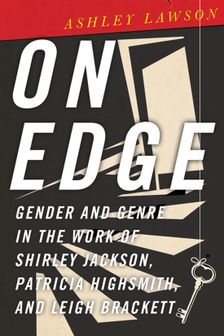
Ohio State University Press On Edge: Gender and Genre in the Work of Shirley Jackson, Patricia Highsmith, and Leigh Brackett Broché

Ohio State University Press On Edge: Gender and Genre in the Work of Shirley Jackson, Patricia Highsmith, and Leigh Brackett Broché

Tous les 1 prix et vendeurs

Choix le plus populaire – Meilleur prix !
Amazon.be Marketplace· Marketplace
€ 39,16
3 à 4 joursLivraison gratuite
Check de website voor de levertijd | Gratis bezorgd > €20,-
Voir le produit
Voir le produit

Aucun avis n’a encore été écrit

Question 1 sur 4

Tu possèdes ce produit et tu aimerais donner ton avis ? Commence ci-dessous à écrire ton avis. Selon le niveau de détail, écrire un avis prend en moyenne entre 3 et 10 minutes. Avec ton opinion, tu aides les autres visiteurs à faire un meilleur choix et tu tentes chaque mois de gagner 250 € ! Clique ici pour les conditions de l’action.

Quelle note donnes-tu à ce produit ?

Spécifications

Autres caractéristiques
Largeur du produit
15,2 cm
Hauteur du produit
1,2 cm
Longueur du produit
22,9 cm
Guide linguistique
en
Largeur de l'emballage
15,2 cm
Hauteur de l'emballage
1,2 cm
Longueur de l'emballage
22,9 cm
Poids de l'emballage
286 g
EAN
9780814259276

Description du produit

Honorable Mention, 2025 PCA Emily Toth Award For Best Single Work In Women's Studies
Finalist, 2025 Mystery Writers of America's Edgar Awards, Best Critical/Biographical Category
Finalist, Bouchercon New Orleans 2025 Anthony Awards, Best Critical/Non-Fiction
Nominated for the 2025 Macavity Awards, Best Mystery-related Nonfiction/Critical

Ashley Lawson's On Edge presents a new picture of postwar American literature, arguing that biases against genre fiction have unfairly disadvantaged the legacies of authors like Shirley Jackson, Patricia Highsmith, and Leigh Brackett. Each of these women navigated a male-dominated postwar publishing world without compromising their values. Their category-defying treatment of gender roles and genre classifications created suspense in their work that spoke to the tensions of the "Age of Anxiety." Lawson engages with foundational voices in American literature, genre theory, and feminism to argue that, by merging the dominant mode of literary realism with fantastical or heightened elements, Brackett, Jackson, and Highsmith responded to the big questions of their era with startling and unnerving answers. By elevating genre play to a marker of literary skill, Lawson contends, we can secure these writers a more prominent place within the canon of midcentury American literature and open the door for the recovery of their similarly innovative peers.