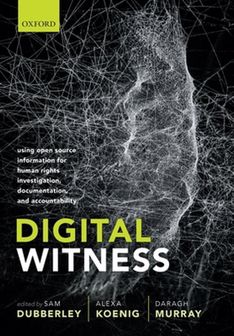
Digital Oxford University Press Digital Witness: Using Open Source Information for Human Rights Investigation, Documentation, and Accountability Paperback

Digital Oxford University Press Digital Witness: Using Open Source Information for Human Rights Investigation, Documentation, and Accountability Paperback

Tous les 2 prix et vendeurs

Choix le plus populaire – Meilleur prix !

Amazon.be· Vendeur reconnu
€ 36,97
-24% prijsdaling
3 à 4 joursLivraison gratuite
Check de website voor de levertijd | Gratis bezorgd > €20,-
Voir le produit
Voir le produit
Amazon.be Marketplace· Marketplace
€ 36,97
3 à 4 joursLivraison gratuite
Check de website voor de levertijd | Gratis bezorgd > €20,-
Voir le produit
Voir le produit

Spécifications

Overige kenmerken
Verpakking lengte
24,4 cm
Verpakkingsgewicht
726 g
Verpakking breedte
16,8 cm
Taal handleiding
en
Product breedte
16,9 cm
Product lengte
24,3 cm
Product hoogte
1,9 cm
Verpakking hoogte
2,5 cm
EAN
9780198836070

Description du produit

This book covers the developing field of open source research and discusses how to use social media, satellite imagery, big data analytics, and user-generated content to strengthen human rights research and investigations. The topics are presented in an accessible format through extensive use of images and data visualization.


From videos of rights violations, to satellite images of environmental degradation, to eyewitness accounts disseminated on social media, human rights practitioners have access to more data today than ever before. To say that mobile technologies, social media, and increased connectivity are having a significant impact on human rights practice would be an understatement. Modern technology - and the enhanced access it provides to information about abuse - has the potential to revolutionise human rights reporting and documentation, as well as the pursuit of legal accountability. However, these new methods for information gathering and dissemination have also created significant challenges for investigators and researchers. For example, videos and photographs depicting alleged human rights violations or war crimes are often captured on the mobile phones of victims or political sympathisers. The capture and dissemination of content often happens haphazardly, and for a variety of motivations, including raising awareness of the plight of those who have been most affected, or for advocacy purposes with the goal of mobilising international public opinion. For this content to be of use to investigators it must be discovered, verified, and authenticated. Discovery, verification, and authentication have, therefore, become critical skills for human rights organisations and human rights lawyers. This book is the first to cover the history, ethics, methods, and best-practice associated with open source research. It is intended to equip the next generation of lawyers, journalists, sociologists, data scientists, other human rights activists, and researchers with the cutting-edge skills needed to work in an increasingly digitized, and information-saturated environment.

Avis

Aucun avis n’a encore été écrit

Tu possèdes ce produit et tu aimerais donner ton avis ? Commence ci-dessous à écrire ton avis. Selon le niveau de détail, écrire un avis prend en moyenne entre 3 et 10 minutes. Avec ton opinion, tu aides les autres visiteurs à faire un meilleur choix et tu tentes chaque mois de gagner 250 € ! Clique ici pour les conditions de l’action.

Quelle note donnes-tu à ce produit ?