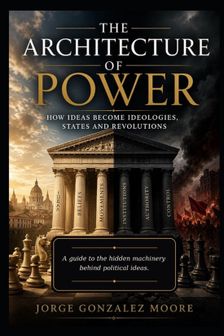
Ideas do not rule the world by remaining ideas. They rule when they become power.
In The Architecture of Power, Jorge Gonzalez Moore examines the hidden journey by which political ideas become ideologies, ideologies become movements, and movements become institutions capable of governing, taxing, educating, regulating, punishing and reshaping society.
This is not a conventional textbook on political theory. It is an inquiry into the machinery beneath political language - the point at which noble words such as liberty, equality, justice, democracy, nation, welfare, tradition and progress are transformed into systems of authority.
Across sixteen powerful chapters, the book explores the great ideological forces that have shaped the modern world: liberalism, socialism, Marxism, conservatism, republican freedom, the welfare state, the market, nationalism, democracy and the modern state. Each is examined not merely by what it promises, but by what it must build in order to deliver that promise.
What happens when equality becomes administration?
When liberty becomes market order?
When democracy becomes majority power?
When welfare becomes both dignity and dependency?
When the nation becomes sacred?
When conservatism preserves wisdom - or defends injustice?
When socialism names exploitation - or creates new masters?
>At the centre of the book is one urgent question:
What kind of power is being built - and who will be safe from it?
Written with intellectual force, moral clarity and a deep suspicion of every ideology that seeks unchecked authority, The Architecture of Power invites readers to look beyond slogans and inspect the foundations beneath every political promise.
It is a book for citizens, leaders, thinkers and anyone who wants to become harder to manipulate by the language of power.