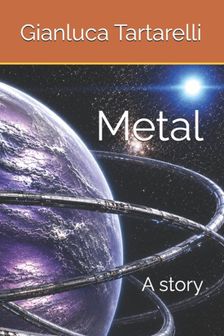
Gianluca Tartarelli Books Ink. - Métal : une histoire

Gianluca Tartarelli Books Ink. - Métal : une histoire

Tous les 1 prix et vendeurs

Choix le plus populaire – Meilleur prix !

Amazon.be· Vendeur reconnu
€ 8,93
3 à 4 joursVerz. € 2,49
Check de website voor de levertijd | Gratis bezorgd > €20,-
Voir le produit
Voir le produit

Spécifications

Informations sur l'étiquette
Nom du fabricant
Libri GmbH
EAN
9798192795477
Guide linguistique
en
Largeur de l'emballage
15,2 cm
Hauteur de l'emballage
1 cm
Longueur de l'emballage
22,9 cm
Poids de l'emballage
204 g
Végane
Non
Acides gras polyinsaturés
Non
Adapté aux enfants
Non
Nom du participant responsable du marché dans l'UE
Libri GmbH

Description du produit

Carbon, the structural scaffolding of life on Earth, thanks to the symmetric stability of its covalent
bonds, has an ancestral and inextricable kinship with the elements of the transition zone of the periodic
table; in fact, approximately one-third of the human proteome is composed of metalloproteins. The planet
"Metallo" represented a thermodynamic and geochemical heresy: a remote world of seas of ammonia and
oceans of water, where life had transcended the limits of organic chemistry to structure itself on
complex nuclear bonds, and the very consciousness of the native species was not a biological epiphenomenon,
but the result of a quantum phase transition, mediated by collective spin waves, propagating through
the nervous system based on lanthanide elements. For these ancient organisms, time was a vector tied
to the half-life of their nuclear fuel. Life arose from the catalytic activity of alkaline hydrothermal
vents similar to those on Earth, with the same iron-sulfur catalytic centers, the origin of the first
metabolic reactions on Earth. Beyond this, humans and Bio-meta had something else in common: the search
for resources and a passion for science. It was precisely because of human research into the riches of
"Metal" that the two civilizations first came into contact, through a physical anomaly that baffled
Earth's scientists. The pulse of a human exploratory probe, sent to study the unusual thermonuclear
signature of the planet "Metallo", was perceived by its inhabitants as a "distorting eddy current" in
their spin networks and emitted a flux of neutrinos capable of disrupting binary telemetry reception
on Earth. However, by recoding the probe at the atomic level, it became a biological extension of "Metallo",
sending far more complex data. Cooperation between the two species led to an advancement for humans
toward synthetic-organic technology, with the construction of the first long-range hybrid spaceship,
allowing Earthlings to travel faster than the speed of light without experiencing time dilation and
reach the mysterious planet.

Aucun avis n’a encore été écrit

Question 1 sur 4

Tu possèdes ce produit et tu aimerais donner ton avis ? Commence ci-dessous à écrire ton avis. Selon le niveau de détail, écrire un avis prend en moyenne entre 3 et 10 minutes. Avec ton opinion, tu aides les autres visiteurs à faire un meilleur choix et tu tentes chaque mois de gagner 250 € ! Clique ici pour les conditions de l’action.

Quelle note donnes-tu à ce produit ?