Libri GmbH Physique Broché

Libri GmbH Physique Broché

Tous les 1 prix et vendeurs

Choix le plus populaire – Meilleur prix !

Amazon.be· Vendeur reconnu
€ 45,08
-35% prijsdaling
6 jours ou plusLivraison gratuite
Check de website voor de levertijd | Gratis bezorgd > €20,-
Voir le produit
Voir le produit

Aucun avis n’a encore été écrit

Question 1 sur 4

Tu possèdes ce produit et tu aimerais donner ton avis ? Commence ci-dessous à écrire ton avis. Selon le niveau de détail, écrire un avis prend en moyenne entre 3 et 10 minutes. Avec ton opinion, tu aides les autres visiteurs à faire un meilleur choix et tu tentes chaque mois de gagner 250 € ! Clique ici pour les conditions de l’action.

Quelle note donnes-tu à ce produit ?

Spécifications

Introduction et assistance
Mois d'introduction
juni
Année d'introduction
2026
EAN
9798235836785
Personnage applicable
Non
Marquage CE
Non
Largeur du produit
14 cm
Hauteur du produit
1,7 cm
Longueur du produit
21,6 cm
Guide linguistique
en
Largeur de l'emballage
14 cm
Hauteur de l'emballage
1,7 cm
Longueur de l'emballage
21,6 cm
Wifi requis
Non
Connexion de données mobiles possible
Non
Application requise pour une fonctionnalité complète
Non
Bluetooth requis
Non
Peut se connecter à Internet de manière autonome
Non
Partage de données utilisateur requis
Non
Services payants requis
Non
Poids de l'emballage
340 g
EAN
9798235836785

Description du produit

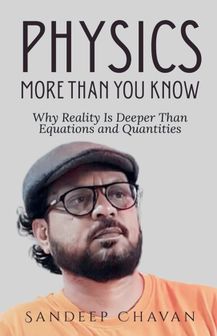
Physics is one of humanity's most precise achievements. It predicts planetary motion, explains electricity and magnetism, guides engineering, describes atoms, and allows us to examine the distant universe. But does a successful equation reveal what reality fundamentally is-or only how selected aspects of reality behave?Physics: More Than You Know begins with a deceptively simple question: did human beings discover force, or did we create the concept to describe recurring changes in matter?From this starting point, teacher, engineer, author, and independent researcher Sandeep Chavan examines the hidden assumptions beneath familiar physical quantities. Force, energy, mass, pressure, temperature, charge, momentum, entropy, fields, space, and time are not dismissed. Instead, they are placed within a deeper hierarchy: reality produces patterns and consequences; observers identify manifestations; measurement converts those manifestations into quantities; mathematics connects the quantities; and theories interpret the relationships.The book explores how physics moved from visible objects to invisible fields, from Newtonian force to spacetime geometry, from solid particles to quantum excitations, and from empty space to a physically significant vacuum. It asks why mathematics describes nature so effectively, whether prediction is the same as explanation, and how scientific language can quietly turn useful abstractions into apparently independent things.Written in accessible language and requiring no advanced mathematics, the book is intended for students, teachers, engineers, science lovers, and readers interested in the philosophy and foundations of physics. It respects established science while keeping its conceptual boundaries visible.The later chapters introduce manifestation science-a broader view of physics concerned not only with measurable quantities, but with how deeper physical structures become observable and measurable.The book also offers a careful introduction to Universal Energy Dynamics (UED) and Structured Vacuum Energy (SVE). UED proposes that matter, fields, interactions, and physical quantities may arise from a continuous and structured energetic foundation. These ideas are presented as a developing research direction rather than established or completed physics. Their future value depends on mathematical formulation, testable predictions, experimental investigation, and openness to revision.At its centre, the book makes a clear distinction:The phenomenon is discovered. The quantity is formulated. The equation represents a relationship. The theory organizes the description. The underlying reality may still remain open.Physics: More Than You Know is not an argument against mathematics or modern physics. It is an invitation to look through their successful vocabulary and ask a deeper question:What is reality actually doing before we name, measure, and calculate it?